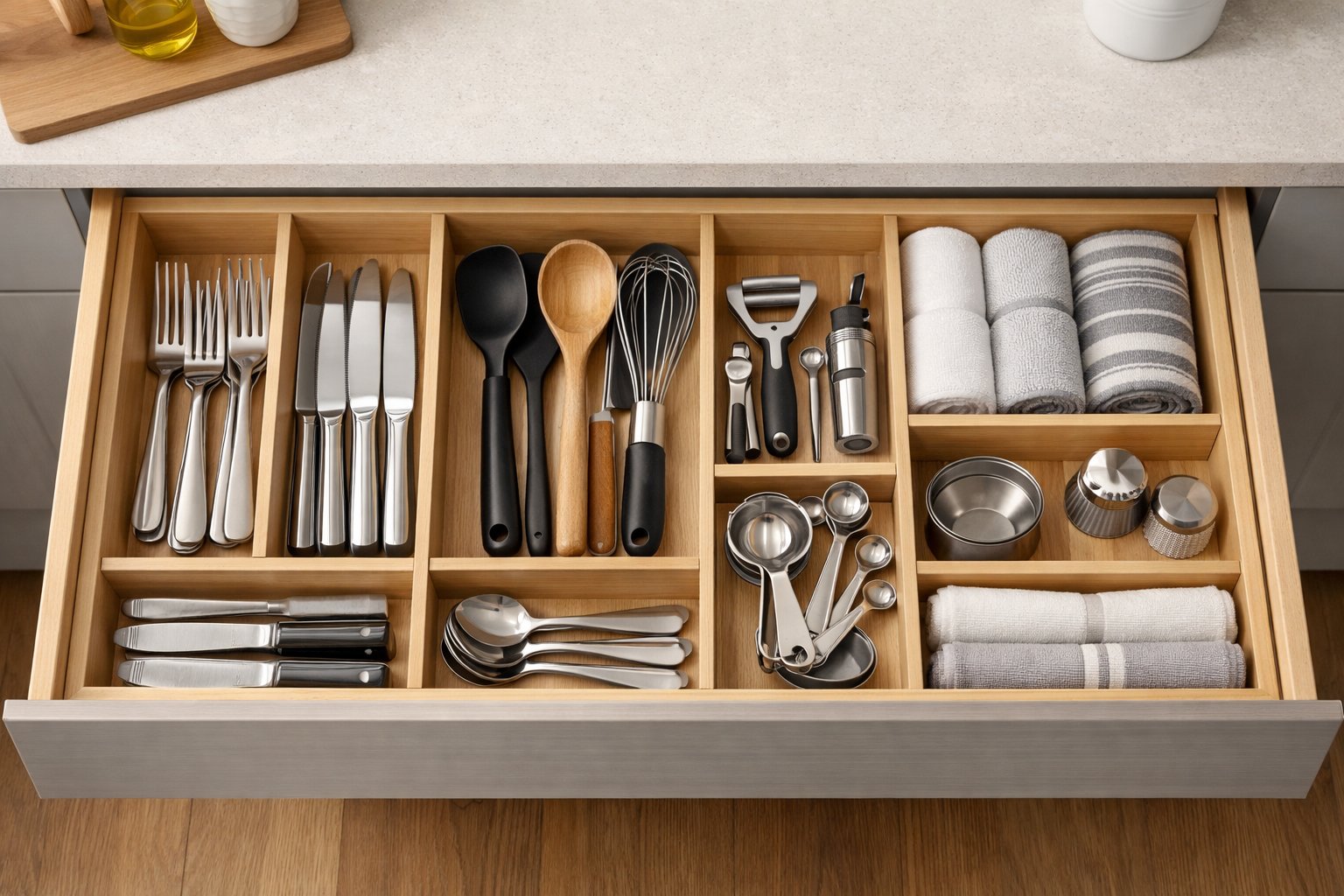

Kitchen drawers have a sneaky way of turning into chaotic catch-alls. You open a drawer for a spatula, and suddenly you’re fishing through a pile of gadgets and random stuff. It’s a daily annoyance that honestly just slows you down and makes cooking less fun.
Organizing your kitchen drawers with smart dividers, clear categories, and a regular declutter can really change your whole kitchen vibe. You don’t need to splurge on fancy systems or lose a whole weekend to the process. A few simple strategies and the right tools can bring lasting order.
Start by pulling everything out, then sort items into groups that make sense for your cooking style. Pick organizers that actually fit your space and the stuff you use. Set up zones for different kinds of tools, and make it easy to keep up with your new system.
Key Takeaways
- Take everything out, toss broken or unused tools, and sort similar items together before you start organizing
- Use dividers and organizers to split drawers into zones for utensils, gadgets, and whatever else you use often
- Keep things organized by always putting items back and giving your system a quick review every few months
Understanding the Importance of Organizing Kitchen Drawers
When your kitchen drawers are organized, you find things faster and feel less stressed. A good drawer system can honestly change the way you work in your kitchen.
Benefits for Kitchen Organization and Efficiency
With organized drawers, you grab what you need in seconds, not minutes. Knowing where every spatula or whisk belongs saves you time and lets you focus on cooking.
You can fit more into the same space when everything has its own spot. Tools don’t get scratched up, and sharp knives stay safe if you store them right.
It’s easier to see what you have, too. You’re less likely to buy duplicates just because you forgot about the one buried in the back. That’s money saved and less waste.
And honestly, a tidy drawer just looks better. It’s more inviting, and you might even feel a little more excited to cook.
Common Kitchen Drawer Challenges
Most of us have at least one overstuffed drawer where everything gets jumbled together. You end up digging for a single whisk, and tools get scratched up in the process.
Little things like bag clips or measuring spoons disappear into the abyss. Before you know it, you’ve got a junk drawer with no real purpose.
Big drawers without dividers just waste space. Items slide around, and different tools mix together, so grabbing what you need becomes a hassle.
Deep drawers are especially tricky. Stuff stacks up and hides what’s underneath, so you forget about tools at the bottom.
How Organization Impacts Kitchen Workflow
When drawers are organized, you can grab the right spatula or knife without breaking your cooking flow. You just move faster and with less stress.
Grouping similar items together makes your workflow more logical. Baking tools in one drawer, cooking utensils in another, so you’re not bouncing all over the kitchen.
Clean-up is easier, too. When everything has a spot, it’s simple to put things away after washing.
If you cook with family or friends, organized drawers make it easy for everyone to find what they need. No more “Where’s the peeler?” every five minutes.
Step-By-Step Guide to Organizing Kitchen Drawers
If you want to tackle your kitchen drawers, you’ll need a plan. Start by emptying everything, measure your space, create zones, and arrange things so you can actually reach them.
Emptying and Assessing Drawers
Pull everything out and spread it on the counter. It’s the only way to see what you’re working with.
Ask yourself if you use each item, if it actually works, and if you have more than one. Be honest here.
Get rid of broken tools, duplicates, and anything you haven’t touched in a year. You might be surprised how many extra spatulas you’ve collected.
Give your drawers a good wipe with soapy water. Clean the sides, bottom, and runners, then let them dry out before putting anything back.
Once everything’s out, you get a better sense of your real storage space.
Measuring and Planning Layouts
Grab a tape measure and write down the width, depth, and height of each drawer. You’ll need these numbers when you shop for dividers or organizers.
Check how far each drawer opens, since some don’t pull out all the way.
Key measurements to record:
- Interior width (left to right)
- Interior depth (front to back)
- Interior height (bottom to top when closed)
- Usable depth (how far back you can actually reach)
Draw a simple sketch of each drawer. Mark where you want dividers based on what you’ll store there. Planning like this means you won’t waste money on organizers that don’t fit.
Assigning Zones: Cooking, Prep, and Storage
Set up a cooking zone near your stove for things you use while making meals. This is where spatulas, tongs, and ladles should go. Oven mitts and pot holders fit here too.
Make a prep zone close to your main counter. Fill it with measuring cups, spoons, whisks, peelers, and graters.
Use other drawers for stuff you don’t need every day, like specialty tools or extra towels. Seasonal gadgets can go here as well.
Keep your most-used items in drawers between waist and chest height. Heavy pots belong in lower drawers, and lighter, rarely used things can go higher up.
Group similar items in each zone. All baking tools in one spot, all cutting tools in another. It just makes life easier.
Arranging Items for Accessibility
Put the things you grab every day at the front of the drawer. Less-used items can hang out in the back.
Dividers help keep utensils upright and separated, so they don’t slide around every time you open the drawer.
Accessibility tips:
- Keep knives in a separate dock or with blade guards
- Roll kitchen towels instead of folding them flat
- Clip measuring spoons together so you don’t lose them
- Heavy stuff goes in wide, shallow sections
Leave a little empty space in each drawer. If you cram too much in, you’ll just end up frustrated again.
If several people use your kitchen, label the divider sections. It helps everyone keep things in the right place.
Decluttering Kitchen Drawers for Lasting Organization
Getting rid of extra stuff is really the heart of any organized drawer. If you’re ruthless about decluttering, you’ll make space for what you actually use and keep clutter from creeping back in.
Declutter Ruthlessly: What to Keep, Donate, or Discard
Dump everything from a drawer onto the counter. Sort it into three piles: keep, donate, and toss. Only keep tools you’ve used in the last three months, if you want to be honest with yourself.
Donate duplicates or gadgets you haven’t touched in ages, as long as they’re in good shape. That avocado slicer you never used? Someone else might want it.
Toss anything broken, rusty, or missing parts. Bent whisks, chipped measuring cups, and stained utensils don’t deserve a spot in your kitchen.
Keep items that are:
- Used weekly or daily
- In good working condition
- Part of a complete set
- Needed for specific cooking jobs
Donate or discard items that are:
- Broken or beyond repair
- Unused for half a year or more
- Duplicates of something you already like better
- Single-use gadgets you never reach for
Handling Duplicates and Rarely Used Items
Don’t let five spatulas or three can openers hog your drawer space. Keep the one you love, ditch the rest. Go for quality and comfort over quantity.
Move rarely used tools out of the main drawers. Stash things like turkey basters or icing tips in upper cabinets or the pantry. They don’t need prime real estate if you only use them once a year.
If you’re not sure which duplicate to keep, ask yourself which one you grab first. That’s the keeper. Try this with measuring cups, whisks, and peelers too.
Maintaining an Organized System
Try to make it a weekly habit to put everything back where it belongs. It only takes a minute or two, but it keeps chaos at bay.
Every few months, give your drawers a quick review. Pull out anything new that doesn’t fit, and toss tools that have worn out.
Don’t add a bunch of new stuff all at once. When you buy something new, let go of something old. That one-in, one-out rule keeps things under control.
Label drawer sections if your kitchen has multiple users. Simple labels help everyone return things to the right place. Use a label maker or stick-on tags that won’t mess up your drawers.
Using Drawer Dividers and Organizers Effectively
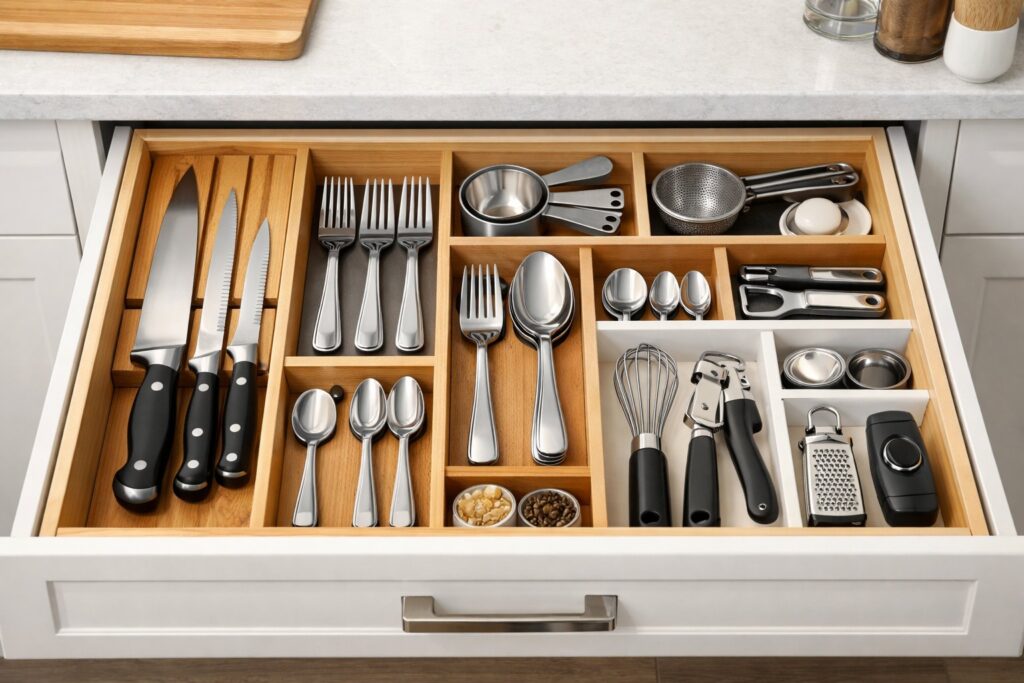
Dividers and organizers can turn a cluttered mess into a drawer that actually works for you. The best divider depends on what you’re storing and how often your needs change.
Choosing Between Fixed and Adjustable Drawer Dividers
Fixed dividers are great if you already know what you want to store and those items don’t change much. They create permanent sections that stay put, which works well for utensil drawers where forks, spoons, and knives always need the same space.
Adjustable dividers let you tweak your drawer layout whenever your needs shift. You can move them around to fit new tools or reorganize after buying different cookware.
Most adjustable dividers use tension rods, sliding tracks, or removable pegs to keep things secure. These are especially handy for deep drawers where you stash pots, pans, and baking sheets.
You can make wide sections for big items and slim slots for things like cutting boards or trays. Adjustable dividers also shine in utility drawers where the mix of stuff changes all the time.
Fixed options usually cost less and go in faster, but you lose the ability to adapt the space later.
Optimizing with Expandable Drawer Dividers
Expandable drawer dividers stretch to fit different drawer widths and don’t need tools or permanent installation. They use spring-loaded parts or adjustable arms that reach from one side of the drawer to the other.
These work best in standard-depth drawers for utensils, flatware, or small tools. You can position several expandable dividers side by side or crisscrossed to make custom compartments.
This way, serving spoons stay separate from spatulas, and measuring cups don’t get mixed up with cooking utensils. Expandable dividers are a lifesaver if you move often or just want to reorganize without buying new stuff.
They move easily between drawers of different sizes, and the spring tension keeps them locked in place during daily use. Look for expandable options with non-slip feet or rubber grips so they don’t slide around when you open or close drawers quickly.
Stackable and Tiered Organizers for Maximum Space
Stackable organizers help you use the vertical space in deep drawers instead of letting things pile up. You can put one organizer on the drawer bottom and stack another on top, doubling your storage in the same spot.
This works for spices, small containers, or kitchen wraps. A tiered spice rack insert angles jars so labels face up, making every bottle easy to spot without pulling anything out.
Tiered organizers also work in utensil drawers by keeping your go-to tools on the top layer and backup or specialty tools underneath. No more digging through everything to find what you need.
Always check that your drawer organizers have enough clearance when the drawer closes. Measure the inside height before buying stackable options so stuff doesn’t get crushed or block the drawer from closing.
Categorizing and Zoning Kitchen Drawers
Sorting your kitchen stuff into clear categories and giving each category its own zone where you use it most can really save time and cut down on clutter.
Grouping Tools by Category
Start by sorting your kitchen items by what they do. Common categories are flatware (forks, spoons, knives), cooking utensils (spatulas, ladles, tongs), baking tools (measuring cups, whisks, cookie cutters), and specialty items (can openers, peelers, thermometers).
Keep similar items together. For example, stash all your measuring tools in one spot instead of spreading them out.
Serving utensils like big spoons and salad tongs go in one section, while everyday eating utensils belong in another. If you keep food storage stuff in drawers, make a category for lids and containers.
A lid organizer keeps these upright and stops them from toppling over or getting lost. You might also want categories for knives, wooden spoons, or small gadgets depending on what you use most.
Establishing Drawer Zones for Function
Put your categories in zones that match where you use them. The cooking zone near the stove should have spatulas, wooden spoons, tongs, and other tools you grab while cooking.
This way, you don’t waste steps during meal prep. Set up a prep zone near your main counter workspace with measuring cups, mixing spoons, peelers, and cutting tools.
Keep your flatware drawer close to the dishwasher or dining area for easy unloading and setting the table. If you have a baking area, store those supplies nearby.
Less-used items can go in lower drawers or spots farther from your main work areas.
Storing Items Vertically and Horizontally
Use vertical storage to get the most out of your drawer depth and keep things visible. Stand cutting boards, baking sheets, and pot lids on their edges using dividers or slots.
This keeps you from stacking and makes it easy to grab what you need without messing up the rest. Arrange utensils horizontally in divided sections so you can see everything at once.
Shallow trays work for flatware and small tools. For deeper drawers, stackable organizers or tiered inserts create more levels but still let you reach things easily.
Store knives in a horizontal in-drawer knife block to protect both the blades and your fingers. Put long tools like rolling pins or whisks horizontally in wide compartments so they don’t bend or break.
Examples of Organized Kitchen Drawers
Real examples make it easier to imagine how different drawer setups could work in your kitchen. The best system depends on what you store and how much space you have.
Utensil Drawers: Trays and Custom Dividers
A utensil tray is probably the most common way to organize forks, knives, spoons, and serving utensils. Standard trays have 5 to 8 compartments to separate everything by type.
You can find expandable trays that adjust from 12 to 18 inches wide to fit your drawer. For deeper drawers, try a two-tier system with everyday silverware on top and serving spoons, spatulas, and whisks underneath.
This setup gives you more storage without adding clutter. Drawer organizers with adjustable dividers are great for tools of different sizes.
Make narrow slots for measuring spoons and wider ones for spatulas or tongs. Bamboo dividers are popular since they’re sturdy and easy to wipe clean.
If you’ve got lots of specialty tools, a pegboard system can help. Little pegs hold each utensil in place, so nothing slides around when you open the drawer. This works especially well for tools with holes in the handles.
Spice Drawer Solutions and Tiered Inserts
Pull-out spice drawers keep jars visible and stop you from buying duplicates. Clear containers with labels let you spot everything at once instead of digging through a cabinet.
Most spice drawer inserts are angled so you can read labels without picking up each jar. Tiered inserts create three levels in one drawer, with the back row highest, the middle row lower, and the front row lowest.
This stair-step layout means you can see every spice label at a glance. Standard spice jars are about 4 inches tall, so measure your drawer depth before buying an organizer.
You need at least 3 inches of clearance for the drawer to close with an insert inside. Some systems have adjustable dividers so you can mix spice storage with small items like measuring spoons or citrus zesters.
Drawer Organization for Lids and Containers
A lid organizer solves a classic kitchen headache. Tension rods installed vertically create slots where lids stand upright instead of stacking flat.
You can grab the size you need without unstacking the whole pile. File organizers also work well for lids, keeping different sizes separated and visible.
This method works for pot lids, storage container lids, and even cutting boards. For food storage containers, nest same-shaped containers inside each other and stash all the matching lids together in a separate spot.
Square containers usually stack more efficiently than round ones and waste less drawer space. Deep drawers can hold baking sheets and cutting boards if you add vertical dividers every few inches.
This keeps flat items from sliding around and makes it easy to pull out just one piece without disturbing the rest.
Recommended Products for Kitchen Drawer Organization
The right products make organizing drawers a lot easier. Good dividers and organizers keep things separated, stop shifting, and help you get the most from your space.
Expandable Drawer Dividers: Utoplike Bamboo Dividers
These bamboo dividers adjust to fit drawers between 15 and 20.6 inches wide. You can buy them in two size ranges depending on your drawer measurements.
They come in gray, black, and natural bamboo colors to match your kitchen. The ends have rubber pads that grip the drawer sides, so the dividers don’t slide when you open and close the drawer.
You can move them to different drawers if you reorganize or move to a new place. The bamboo is sturdy and resists water better than plastic.
Each set includes four dividers you can arrange however you like. This works for separating utensils, kitchen tools, or baking supplies. The natural bamboo finish gives any drawer a clean look.
Multi-Compartment Utensil Trays
A good utensil tray has sections for forks, knives, spoons, serving utensils, and small tools. Look for trays with at least five to eight compartments.
Some trays stack in two layers to double your storage without using more drawer space. Choose bamboo, plastic, or stainless steel based on what you like.
Bamboo looks great and handles moisture. Plastic trays are light and budget-friendly. Stainless steel is best for commercial kitchens or if you like a modern vibe.
Measure your drawer before buying any tray. It should fit snugly without too much space on the sides. Some trays have expandable sides to adjust to your drawer width.
Tiered Spice Rack Inserts and Lid Organizers
A tiered spice rack insert adds steps inside your drawer so you can see every bottle. The back bottles sit higher than the front ones.
This setup is better than storing spices flat since you can read all the labels at once. Lid organizers use vertical slots or adjustable dividers to stand container lids on their sides.
This saves space and keeps lids from getting lost at the bottom. Some organizers use tension rods that expand to fit your drawer width.
You can use tiered organizers for cutting boards, baking sheets, or even tablets. The angled design keeps flat items separated and easy to grab.
Pick organizers with non-slip feet so they stay put when you open the drawer.
Frequently Asked Questions
Kitchen drawer organization brings up a lot of practical questions, from picking the right dividers to keeping order in tricky drawers. Here are some answers to common challenges, with specific solutions for dividers, decluttering, categorizing, and making the most of your space.
What are the most effective dividers to use when organizing kitchen drawers?
Bamboo expandable dividers work for most kitchen drawers since they adjust to fit different sizes. They’re sturdy and hold up to daily use without sliding around.
Acrylic dividers let you see your stuff and are easy to clean. They’re great in drawers where you want everything visible, like utensils or baking supplies.
Spring-loaded dividers need no installation and can move as your needs change. They make firm compartments without drilling or sticky stuff. For deep drawers, find dividers at least 3 inches tall to keep things separated.
What strategies can be employed to declutter and maximize space in kitchen drawers?
Start by emptying your drawers and sorting everything into three groups: things you use weekly, things you use monthly, and things you rarely touch. If you haven’t used something in a year, it’s probably time to donate or toss it.
Use the vertical space in drawers by adding shallow trays or small boxes that stack. This works well for small items like measuring spoons, tea bags, or spice packets.
Keep similar items together in containers instead of letting them scatter. Try the one-in-one-out rule to avoid future clutter. When you buy a new spatula, get rid of an old one.
Put your most-used items in the front and less-used stuff in the back of the drawer.
Could you provide examples of how to categorize items in kitchen drawers for better workflow?
Create a cooking utensils drawer. Group wooden spoons, spatulas, tongs, and whisks by type.
Keep this drawer close to your stove. That way, you can grab what you need without wandering around.
Set aside a different drawer for baking tools. Toss in measuring cups, pastry brushes, rolling pins, and cookie cutters.
Put this baking drawer near your main workspace. It makes baking days slightly less chaotic.
Add a drawer just for prep tools like vegetable peelers, graters, can openers, and knives. Position it close to your cutting board area.
Reserve another drawer for food storage items. Stash plastic wrap, aluminum foil, food storage bags, and twist ties near your fridge.
What are the best practices for maintaining an organized snack drawer?
Use clear bins or containers to separate snacks. Granola bars, chips, crackers, and dried fruit each get their own spot.
This setup helps avoid forgotten snacks hiding in the back. It also makes it easier to see what you actually have.
Label each container or section with the snack type. That way, everyone knows where things go.
Check the drawer every week. Remove empty packages and toss anything expired.
Put snacks with the earliest expiration dates in front. If you want to nudge healthier choices, keep those at eye level or right up front.
Can you recommend some high-quality organizers suitable for large kitchen utensils?
The SimpleHouseware Kitchen Drawer Organizer has deep compartments for big spatulas, ladles, and serving spoons. It measures about 17 inches long, so it fits most standard kitchen drawers.
OXO Good Grips Expandable Utensil Organizer adjusts from 10 to 17 inches wide. The compartments can handle bulky items, and the non-slip feet keep it steady even if you slam the drawer shut.
YouCopia Chef’s Edition Spice Stack holds up to 30 bottles. It also works for larger spice containers or small kitchen tools, and the angled design lets you see labels without shuffling everything around.
Which stackable organizers are recommended for deep kitchen drawers to optimize space?
The mDesign Plastic Stackable Kitchen Storage Organizer Bins come in sets of four. You can stack them two levels high in drawers at least 6 inches deep.
Each bin stands about 3 inches tall. Handles make it easy to pull them out when you need something.
Copco Non-Skid Pantry Cabinet Lazy Susan actually works in deep drawers if you lay it flat. It creates rotating storage for oils, vinegars, or sauce bottles, which is honestly pretty handy.
The 9-inch diameter fits most standard drawers. You might need to double-check your drawer size, but it usually works.
InterDesign Linus Drawer Organizers come in several heights, from 2 to 4 inches. Stack the shorter ones in deep drawers to get two layers of storage, which is a nice space saver.
The clear plastic design lets you see what’s inside right away. No need to open every container just to find that one thing you need.